The Secret Isn’t the Slime. It’s What Happens to the Teachers — They Fall in Love with Science First.
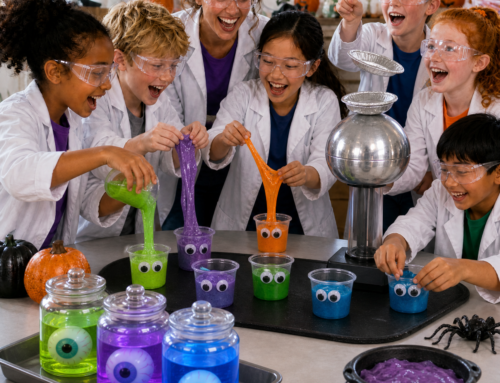
People often ask me what makes Junior Einsteins Science Club® different from every other primary science programme out there. They expect me to say the slime. Or the rockets. Or the moment a Van de Graaff generator makes Barbie’s hair stand on end and thirty children scream with laughter. The Secret Isn’t the Slime It’s What Happens to the Teachers — They Fall in Love with Science First.
Those moments matter. But they’re not the secret.
The secret is what happens to the adult in the room.
We don’t replace your science curriculum. We bring it to life.
Let me be clear about something first, because it matters to every school we work with: Junior Einsteins is not a replacement for your curriculum. Your curriculum is the map. We’re the journey.
The curriculum says children should understand forces. We hand them Nerf guns and skateboards and let them *feel* Newton’s laws in their own two hands. The curriculum says materials and their properties. We make elephant’s toothpaste erupt across the table. Living things and their habitats? We extract real DNA from a banana, hunt for mini-beasts, cast fossils children carry home and put on their bedroom shelves.
Every session maps cleanly to the frameworks schools are judged on — British curriculum, IB PYP, IPC, NGSS and more. But alignment is the floor, not the ceiling. We go where the curriculum never dares: quantum physics for eight-year-olds. Biomimicry. Forensic crime scenes. Bioluminescence. Children this age are not too young for big ideas. They are exactly the right age — curiosity has no minimum height requirement.
That’s what I mean when I say we enhance, strengthen, and go above and beyond. We take the science your school already teaches and make it the thing children talk about at dinner.
Here is what I’ve learned in over twelve years of working inside primary schools, from Dublin to Riyadh: a science programme lives or dies on whether the teacher wants to run it.
Not whether they’re told to. Whether they *want* to.
Most science resources are written for schools. Ours are written for the human being standing in front of a class at two o’clock on a Wednesday afternoon, who may not have picked up a test tube since their own school days, and who has forty other things on their mind.
So every Junior Einsteins script reads like a story, not a manual. The wow moment is planned. The words are on the page. The equipment list is there down to the last wooden skewer, with an alternative for every item. The science is explained so clearly that teachers tell us the sessions are where *they* finally understood static electricity, or vortices, or what quantum actually means.
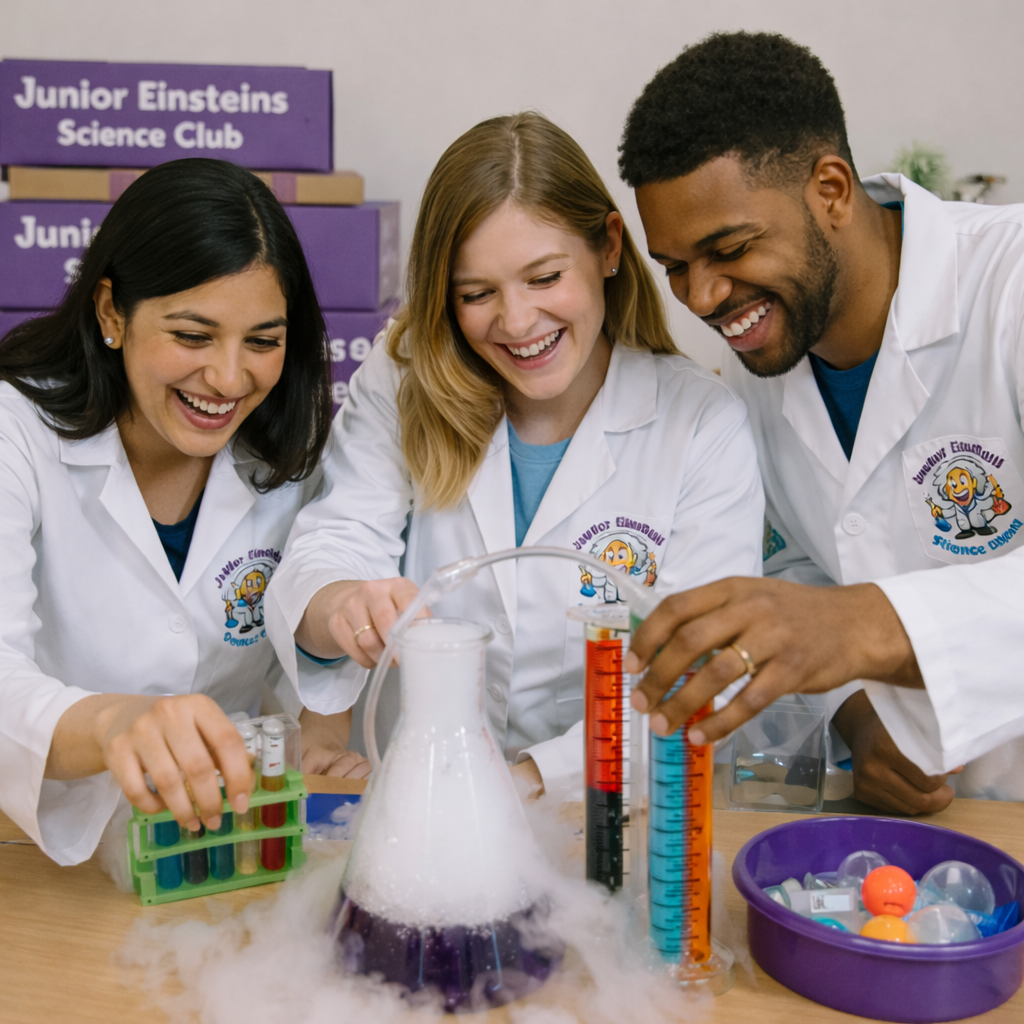
And something lovely happens. The teacher stops being the person supervising an activity and becomes a scientist alongside the children. They gasp at the colour change too. They want to know if the rocket will fly. They read next week’s script at home — not because anyone asked them to, but because they’re curious what’s coming.
That is the key. That has always been the key.
Because a programme teachers dread ends up in a cupboard, and a cupboard never taught a child anything. A programme teachers love runs every single week, in every classroom, for years. The enthusiasm children catch in a Junior Einsteins session? They catch it from the adult holding the plasma ball.
Fascinating for children. Irresistible for teachers.
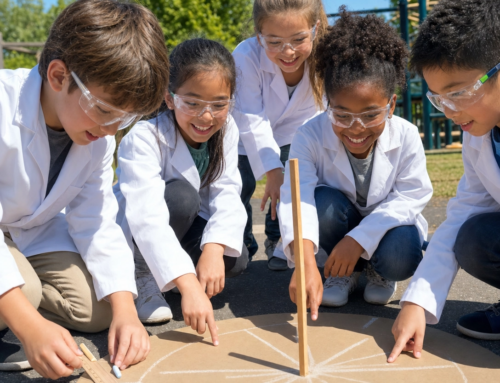
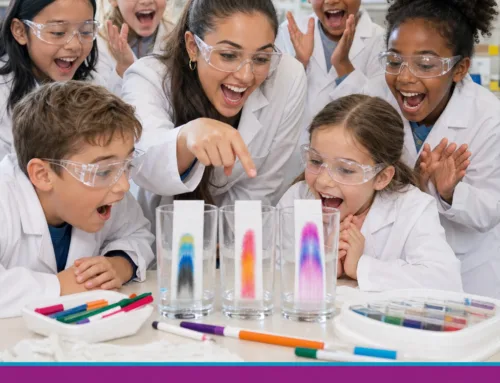
Everything else we’re known for flows from this. Children work in small groups of four or five, real teamwork, real roles, real negotiation. Almost every session ends with something made and taken home: a working periscope, a lava lamp, a fingerprint card from the crime scene they just solved. No screens anywhere — hands-on is the whole point. And a school can run our sessions weekly for two full years without repeating a single topic, so no child ever says “we did this last year.”
Teachers save seven or more hours of preparation every week. Children get science that feels like the best hour of their week. Schools get a STEM identity that parents notice at open days and remember at enrolment time.
But if you ask me what really sets Junior Einsteins Science Club® International school STEM education model apart, it’s this: we made primary science something teachers genuinely look forward to. Lab coats on. Equipment out. Full engagement — and I mean everyone in the room.
Junior Einsteins Science Club® licenses its complete hands-on STEM system to primary and international schools — session scripts, teacher training through our online Academy, and two years of weekly sessions with no repeats. If you’d like to explore what that could look like in your school, email welcome@junioreinsteinsscienceclub.com — We’d love to chat*
welcome@junioreinsteinsscienceclub.com
#InternationalSchools #SchoolLeadership #PrimaryEducation #STEMeducation #HandsOnLearning #ScienceEducation #IBPYP #BritishCurriculum #InternationalEducation #HeadsOfSchool #EdLeadership #TeacherDevelopment #STEAM #EnrichmentPrograms #JuniorEinsteinsScienceClub