The Premier Primary Science System for Scaling STEM Across International Primary Schools
Every international school I speak to tells me a version of the same story. They want outstanding STEM provision. Parents expect it, accreditation frameworks demand it, and children love it. But the person asked to deliver it is usually a busy classroom teacher with no science background, no time to plan practical lessons, and no support when the STEM coordinator who built the programme moves on in June.
That is the problem Junior Einsteins Science Club® was built to solve. Not with another app or another screen, but with a complete, ready-to-run primary science system that any teacher can deliver with confidence.
What the system actually is
The Junior Einsteins Science Club® gives a school years of weekly, 60-minute hands-on science sessions with no repeated topic. Every session script includes learning aims, risk assessments, differentiation, equipment lists and the pedagogy behind it, so a non-specialist teacher can walk in prepared. Schools tell us it saves their teachers seven or more hours of STEM preparation a week.
Teachers train and certify through the Junior Einsteins Academy, our online training platform. That matters more than it sounds: it makes the programme system-dependent rather than person-dependent. When staff move on, and in international schools they do, the programme carries on without missing a week.
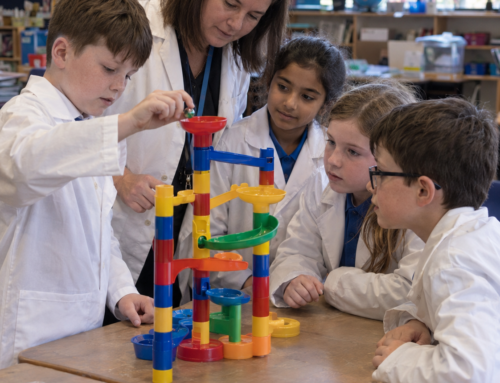
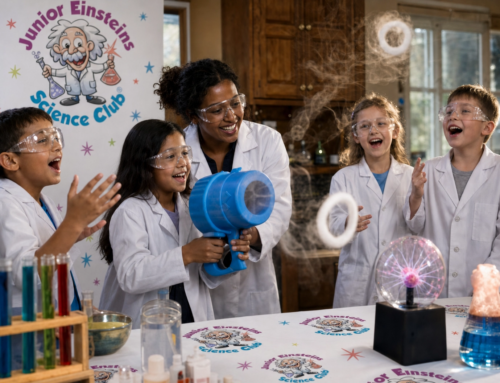
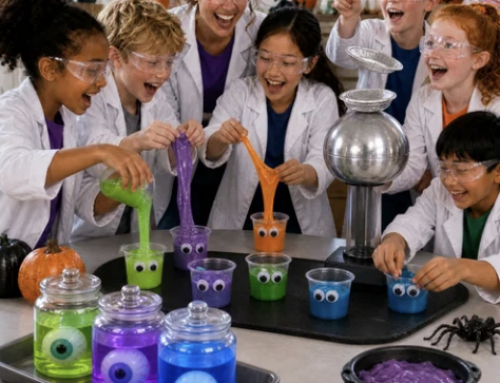
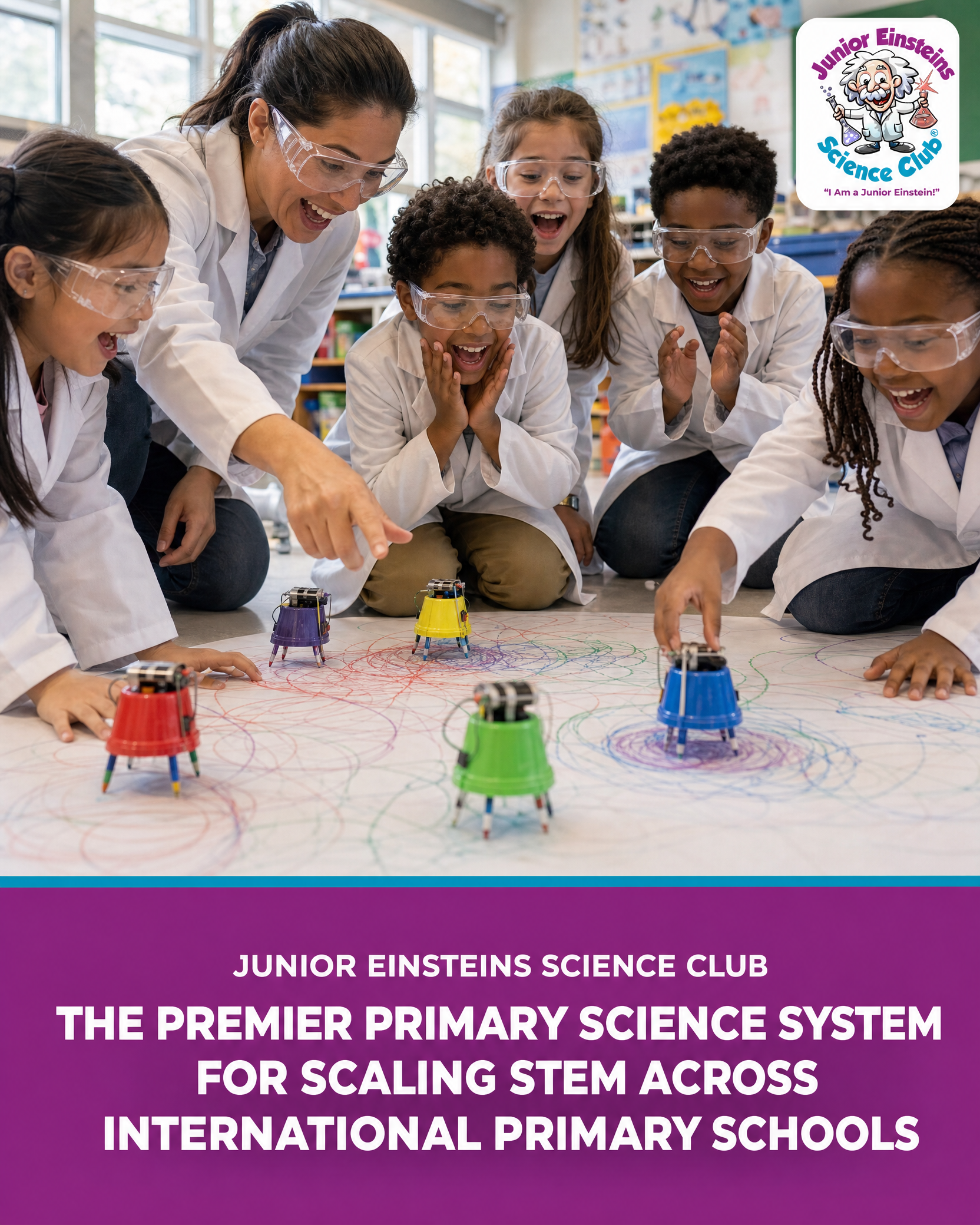
And the children? They never touch a screen. The technology supports the educators so that pupils spend their time experimenting, building, investigating and discovering real science with their own hands. Chemistry, engineering, forensics, anatomy, geology, marine biology, all of it live on the bench in lab coats and goggles.
Depth & Breadth of our curriculum
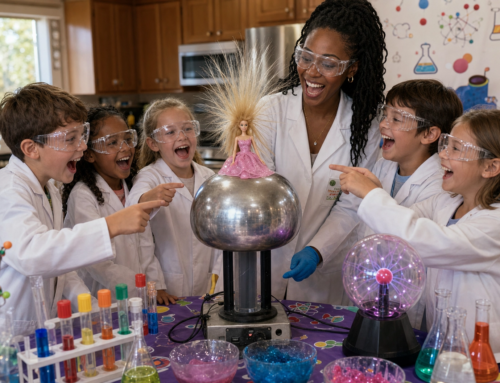
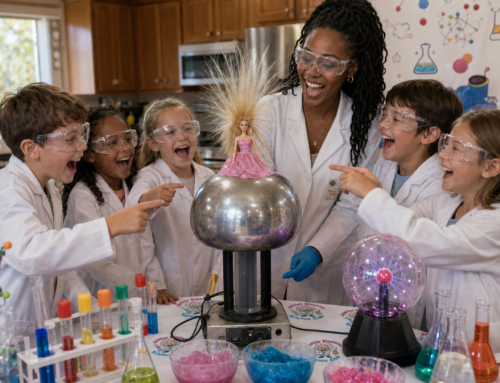
The breadth of what children cover at Junior Einsteins Science Club® is enormous. Across the years our Junior Einsteins explore chemistry through bubbling potions, colour-change reactions, polymers and non-Newtonian fluids; physics through forces, levers, catapults, magnets, light and optics, static electricity with our Van de Graaff generator and lightning with plasma balls; and engineering through bridge building, storm defences, Smart Cities, rocket races, bristle bots, robotics, simple circuits and the science of flight and aerodynamics. They dig into geology and palaeontology with fossils and minerals, uncover the past through archaeology and anthropology, travel through the Solar System, and investigate weather and the wild wind. They study anatomy with skeletons, x-rays and real stethoscopes, explore MedTech and the technology behind modern medicine, discover marine biology and life in our oceans, and turn detective with police and forensic science, lifting fingerprints and solving full crime scene investigations. There is microbiology, glow-in-the-dark science, luminescent lava lamps, Marvellous Magical Maths, Somewhere Over the Rainbow, Pigments of Imagination and dozens more, every one of them hands-on, screen-free and taught through experiments children carry out themselves in lab coats and safety goggles. Years of weekly sessions with no topic ever repeated, covering every letter of STEM.
Aligned with the frameworks you already work in
The curriculum is aligned with Cognia expectations, IB PYP, IPC, NGSS, the British National Curriculum, High Performance Learning and UDL, alongside Cambridge, Australian, Singapore, Canadian, UAE, Saudi, Qatar and New Zealand frameworks. Whichever accreditation pathway your school is on, the Hub slots into it rather than sitting beside it. Schools run it as curriculum science, after-school enrichment, holiday camps, STEM days, and even revenue-generating events.
The proof
We have been doing this for fourteen years. Since 2012, Junior Einsteins has reached over 900,000 children, and we now operate across Ireland, the UK, Luxembourg, Ukraine, Canada and Saudi Arabia. Some of our international school partnerships in Dublin, including Nord Anglia International School, the Lycée Français International Samuel Beckett, the International School of Dublin and Rosemont International School, have been running for over a decade. Schools do not keep a programme for twelve years unless it works.
The recognition has followed. Junior Einsteins won International Franchise of the Year and Leadership in Franchising in Ireland this year, and our founder has been fortunate to speak at the United Nations Headquarters in New York for International Women and Girls in Science Day, with CERN in Geneva to come this November. Mary Robinson president of Ireland put our mission better than we ever could: ‘every child deserves to see themselves as a scientist.’
Our Expansion
We are expanding our international school licensing, with new school partners onboarding in the Middle East this autumn. As a member of COBIS, we understand the realities international schools work within: high expectations, mobile staff, and no time to reinvent provision every year.
If you are a head of school, a head of primary or a STEM coordinator and any of this sounds like your school, we would love to have a conversation. No pitch, just a look at whether Junior Einsteins fits what you are trying to build for your pupils.
You will find us at junioreinsteinsscienceclub.com
Explore • Engage • Empower
#InternationalSchools #PrimaryEducation #STEMeducation #COBIS #IBPYP #BritishInternationalSchools #ScienceEducation #HandsOnLearning #JuniorEinsteins #STEMcoordinator #SchoolLeadership #EdLeadership #PrimaryScience #InternationalEducation #FutureScientists #21stcenturylearning